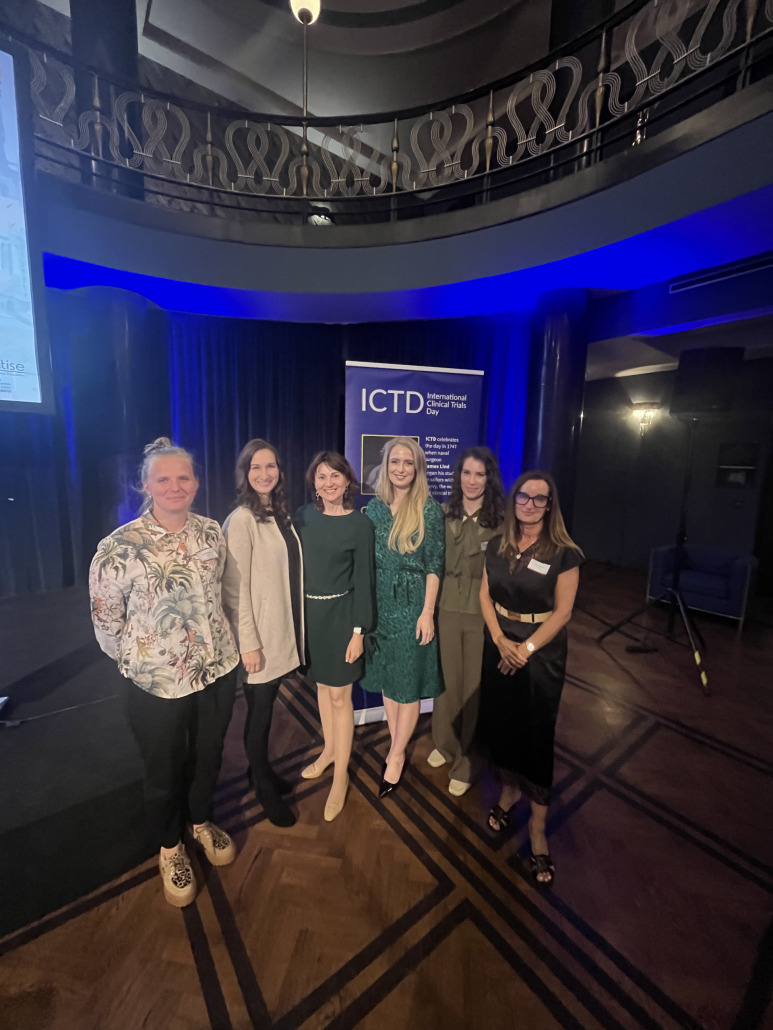
International Clinical Trials Day 2026
Science Park, COMENIUS UNIVERSITY, BRATISLAVA
Klinické skúšania otvárajú pacientom cestu k inovatívnej liečbe. Odborníci vidia nevyužitý potenciál Slovenska v tejto oblasti.
Clinical trials offer patients access to innovative therapies, while experts identify untapped potential for Slovakia in this area.
In 2025, the innovative pharmaceutical industry conducted a total of 183 clinical trials in Slovakia, providing 5,883 patients with access to modern treatment options.
• Slovensko však stále nevyužíva naplno svoj potenciál, najmä v oblasti pokročilých terapií (ATMP – Advanced Therapy Medicinal Products) a zriedkavých ochorení.
• Odborníci sa zhodujú na potrebe zatraktívniť prostredie pre klinické skúšania zlepšením regulačných procesov, posilnením kapacít zdravotníctva a podporou odborných pracovísk.
• Experts agree on the need to make the clinical trial environment more attractive by improving regulatory processes, strengthening healthcare system capacities, and supporting specialized clinical research centers. 2. The conference, held on 2–3 June in Bratislava, was organized by SLOVACRIN – the Slovak Clinical Research Infrastructure Network.
Clinical trials bring benefits to the entire healthcare ecosystem. They enable physicians to work with the latest scientific advances, attract investment into the healthcare system, and provide patients with access to life-saving therapies 10 to 15 years before these medicines become available in standart of clinical practice.
Rare diseases affect approximately 30 million people across the European Union. Despite this, effective treatments are still unavailable for the majority of the more than 6,000 known rare disease diagnoses. Advanced Therapy Medicinal Products (ATMPs), including gene therapies, cell therapies, and tissue-engineered products, represent a promising new treatment option for many of these conditions.
“Clinical trials serve as a bridge between scientific discovery and real-world patient care. In the field of rare diseases, this bridge is particularly important, as many patients currently have no access to effective causal treatments. Gene and cell therapies offer the potential to fundamentally alter the course of a disease and, in some cases, address its underlying cause,” explains Beáta Čečetková, Medical Director of SLOVACRIN.
The development of Advanced Therapy Medicinal Products (ATMPs) is one of the most dynamic areas of biomedical research. These therapies have the potential to deliver breakthrough solutions not only for patients with rare genetic diseases, but also for those with oncological and immune-mediated disorders. Their successful development requires close collaboration among research institutions, regulatory authorities, healthcare providers, patient organizations, and the pharmaceutical industry.
Clinical Trial Activity Remains Low, Restricting Availability of Innovative Treatment.
According to a survey conducted by the Association of Innovative Pharmaceutical Industry (AIFP), the results of which were presented at the conference by Nora Farkašová of AIFP, a total of 183 clinical trials were conducted in Slovakia in 2025.
The highest number of clinical trials was conducted in oncology (51 trials), followed by immunology (38) and cardiology (27). Overall, these studies provided 5,883 patients with access to innovative treatment opportunities.
According to the survey, Slovakia shows significant gaps particularly in the field of Advanced Therapy Medicinal Products (ATMPs) and rare diseases. “Only five member companies conducted clinical trials involving ATMPs,” Farkašová pointed out. Moreover, oncology was the only therapeutic area in which ATMP clinical trials were carried out.
Clinical research in rare diseases also remains limited. “Only four companies were involved in conducting clinical trials in this field, with studies focusing on conditions such as hemophilia A, hemophilia B, and IgA nephropathy,” Farkašová noted.
Slovakia Needs Better Conditions for Clinical Research
The State Institute for Drug Control (ŠÚKL) plays a key role in the conduct of clinical trials. “Our primary responsibility is to ensure patient safety and the appropriateness of medical procedures in compliance with applicable legislation,” explains Jana Schweigertová, an assessor in the Department for the Evaluation of Medicinal Product Efficacy at ŠÚKL and a member of the Committee for Orphan Medicinal Products (COMP) at the European Medicines Agency.
She noted that the significance of clinical trials in Slovakia is further amplified by the presence of specific rare diseases that are disproportionately represented in the region.
She noted that the significance of clinical trials in Slovakia is further amplified by the presence of specific rare diseases that are disproportionately represented in the region.
Schweigertová identified the need for deeper healthcare digitalization and stronger support for smaller scientific teams as key challenges facing Slovakia. “These teams possess considerable expertise and potential; however, without appropriate infrastructure, they cannot fully comply with all legislative and regulatory requirements,” she noted.
Europe Is Losing Clinical Trials
The decline in clinical trial activity is not only a Slovak issue. Europe is currently facing a significant shift of clinical trials to countries such as the United States, China, and India.
According to an IQVIA analysis, 4,527 commercial clinical trials were authorized in Europe between 2022 and 2025. However, Europe’s share of global clinical trials declined from 22% in 2013 to 12% in 2023. According to the analysis, the lost share was largely captured by the United States and China, with China recording a particularly significant increase from 8% to 18%.
According to experts, the primary reason for this trend is the lengthy approval process, an issue that the new European legislation aims to address. “If we want to reverse this trend, we must accelerate and streamline our regulatory processes; otherwise, we risk losing the interest of both investors and clinical trial sponsors,” emphasizes Jana Schweigertová of the State Institute for Drug Control (ŠÚKL). She adds that smaller countries, including Slovakia, face particular disadvantages in this area due to their smaller markets and more limited resources.
An important milestone was Slovakia’s accession as a full member of the European Clinical Research Infrastructure Network (ECRIN) in 2025. This achievement creates new opportunities for Slovak research centers to engage in multinational clinical research initiatives and international collaborative projects.
Clinical Research Brings Economic Benefits
Clinical trials generate significant economic value. In 2025, pharmaceutical companies invested approximately EUR 40 million in Slovakia. “These investments contribute not only to the development of the healthcare system, but also to improving patient access to innovative treatments,” explains Nora Farkašová of the Association of Innovative Pharmaceutical Industry (AIFP).
According to an analysis by Frontier Economics, clinical trials generated a gross value added of EUR 21.7 billion across the European Union and the European Economic Area in 2025. Clinical research also supported approximately 165,000 jobs throughout the region.
European institutions have therefore set ambitious goals. The European Commission and the European Medicines Agency aim to achieve an 11% annual increase in the number of clinical trials. According to the analysis, improving patient participation could provide up to 35,000 additional Europeans with access to breakthrough treatments.
“EU healthcare systems and the European economy could gain an additional EUR 4 billion annually, create 18,000 new jobs, and reduce the number of sick-leave days by three million each year,” experts state in the study.
Quality and Collaboration as Key Success Factors.
The conference in Bratislava also included a dedicated educational program on Good Clinical Practice (GCP), featuring a certified training course based on the latest ICH GCP E6 (R3) guideline. Adherence to these principles is fundamental to ensuring the quality, integrity, and safety of clinical trials.
The course program guided participants through the entire clinical trial process—from drug development and regulatory requirements to trial preparation, patient recruitment and informed consent, as well as trial documentation and investigational product management.
The conference also hosted the second annual meeting of legal professionals and clinical trial office representatives from healthcare institutions. The event provided a platform for discussions on improving contractual arrangements between clinical trial sponsors and healthcare providers participating in clinical research in Slovakia, with a particular focus on enhancing efficiency and fostering closer collaboration between stakeholders.
The outcome of the meeting was the identification of key priorities for future collaboration and the development of practical recommendations in the form of an action plan.
The International Clinical Trials Day 2026 Conference – Innovations for ATMPs and Rare Diseases brought together experts from healthcare institutions, universities, regulatory authorities, and the pharmaceutical industry. The event was held under the auspices of the Ministry of Health of the Slovak Republic and the Ministry of Education, Research, Development and Youth of the Slovak Republic.
________________________